
How to Choose a Side Shift Backhoe Loader for Municipal and Farm Projects
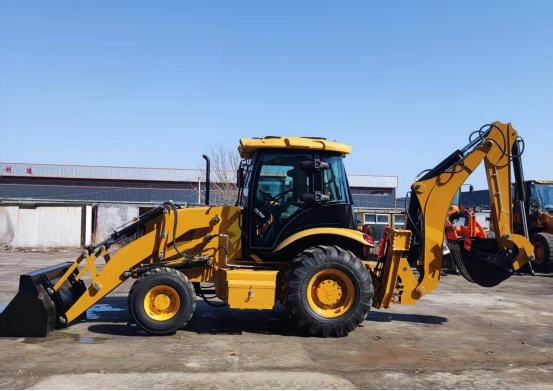
Municipal contractors, utility crews, farm operators, and small earthmoving businesses often need one machine for several changing jobs. A dedicated excavator digs efficiently but may need another machine for loading or grading, while a wheel loader is less convenient for trenching.
A side shift backhoe loader covers that middle ground. The front loader handles material movement and site preparation while the rear backhoe tackles trenches, foundations, drainage, and excavation. The right choice depends on dimensions, hydraulics, attachment compatibility, and supplier support, not horsepower alone.
What Work Should the Machine Cover?
Start with the work sequence rather than the machine brochure. List the tasks the loader will perform during a normal week and identify which end of the machine does each job.
-
Utility and municipal work: trenching for water, drainage, and cable routes; sidewalk repair; road edge maintenance; and emergency clean up.
-
Farm work: irrigation ditches, land leveling, handling bulk feed, and clearing small access routes.
-
Landscape construction: foundation preparation, soil and stone movement, grading, and work around existing structures.
-
Small quarry or gravel yard work: loading loose material and moving it over short distances.
These applications favor a compact machine that travels between sites, works in restricted areas, and changes from digging to loading without a second power unit. For high volume quarry production or deep bulk excavation, a larger dedicated excavator and loader may deliver better output.
Which Specifications Affect Daily Productivity?
Useful specifications match the jobsite. Compare these points.
Operating Weight and Footprint
Take Kingho Technology’s RZ388 Backhoe Loader as a practical example. The RZ388 draws upon the overall design philosophy of the Caterpillar 420F. At the same time, Kingho Technology has incorporated differentiated features, such as a sideshift backhoe assembly and a range of engine options.
The RZ388 has nominal dimensions of approximately 6,120 x 2,410 x 3,763 mm and a ground clearance of 300 mm. An 8,200 kg operating weight gives this class enough stability for general trenching and loading while remaining more transportable than heavy production equipment. Check transport length, width, height, and axle loading against local road limits and your carrier’s equipment.
For buyers familiar with the CAT 420F but working with a more controlled equipment budget, RZ388 is a cost-effective alternative that combines broad backhoe loader capability with flexible configuration.
Drive and Maneuverability
Four wheel drive helps maintain traction on unfinished roads, wet ground, farm lanes, and aggregate yards. A small turning radius matters when the operator repositions between a trench and a spoil pile. Confirm the turning radius with the selected tire package and whether the rear digging unit can side shift without moving the base machine. Side shift travel is useful beside walls, curbs, and existing utility lines.
Engine and Powertrain
RZ388 uses a 76 kW Yunnei 4102 turbo diesel engine. The torque converter and power shift gearbox should deliver smooth travel between loading and excavation areas. Buyers may opt for alternative engine configurations—such as Yunnei, Yuchai, Weichai, Cummins, Perkins, or Euro V—to suit specific emission standards or operating environments. These specific configuration choices are one reason the RZ388 should not be treated as a specification-identical Caterpillar 420F.
Hydraulic Performance
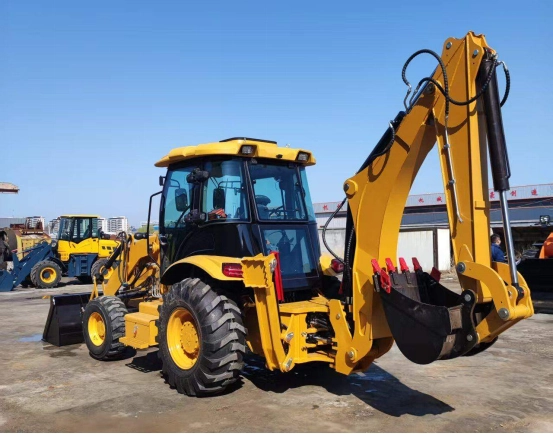
Pilot joystick control can reduce unnecessary hand movement during repeated digging and loading cycles. More important is whether the hydraulic system supplies stable flow to the selected hydraulic attachment. Ask for auxiliary flow and pressure range, relief pressure settings, cycle times, and the hydraulic connection standard before ordering a breaker, auger, grapple, or multi purpose bucket.
Digging and Loading Range
RZ388 gives a maximum digging depth of 4,800 mm and a front bucket capacity range of 0.8 1.0 m3. Read these figures with reach, dump height, breakout force, and bucket geometry. A higher dump height may matter more than extra depth when loading a truck. Trenching crews should prioritize depth, side shift range, control precision, and visibility.
How Should Attachments be Matched?
Attachments make a backhoe loader task specific when the carrier and tool are matched correctly. Hydraulic breakers support concrete and pavement repair; augers suit posts and landscaping; grapples handle logs, scrap, and irregular materials; and a 4 in 1 bucket combines loading, grading, clamping, and light dozing.
Before selecting an attachment, document the auxiliary circuit, coupler dimensions, allowable tool weight, hydraulic flow, and control method. Consider change frequency too. A quick coupler and clearly labeled hydraulic lines can save more time than a small increase in peak power.
Where Does the RZ388 Fit for Buyers Considering a CAT 420F?
For buyers who know the Caterpillar 420F but need to keep acquisition costs under tighter control, the RZ388 is a cost-effective alternative. Its value comes from combining a familiar full-size backhoe-loader concept with Kingho Technology’s specific choices such as a side-shift rear digging unit, multiple engine options, attachment flexibility, and configuration for different markets.
Compare the quoted machine price together with included attachments, hydraulic setup, spare-parts package, warranty terms, shipping, commissioning, and expected service support. A lower purchase price only creates value when the final specification still matches the required digging, loading, transport, and attachment work.
What Should a Supplier Provide Before Purchase?
A machine quote is useful only when it defines the complete build. Request a line by line specification covering the engine, transmission, axle, tires, cab, hydraulic system, buckets, coupler, auxiliary circuit, and optional attachments. Ask which values are standard and which depend on the selected configuration.
Quality and delivery documentation reduce procurement risk. Use the technical and quality service information as a supplier comparison checklist. Ask for factory inspection photographs, a machine test report, packing details, and the agreed inspection point before shipment.
Common shipping options include bulk cargo and flat rack container transport, with EXW, FOB, and CIF terms available for discussion. Confirm destination port, insurance, export documents, spare parts, and commissioning responsibility. These details affect delivered cost more than factory price alone.
Which Ownership Factors Deserve Attention?
For a mixed fleet, uptime and operator acceptance often matter more than a single maximum figure. Check access to filters, hydraulic inspection points, grease points, and engine components. A front opening hood can make routine checks easier, but the supplier should still provide a maintenance schedule and parts list.
Cab visibility and operator comfort influence productivity. RZ388 uses a full view, shock absorbing operator cab with a rotating vibration reduction seat and formed safety glass. Confirm cab protection, lighting, mirrors, and climate control options for the destination market. Also evaluate the supplier’s ability to support future changes.
What Information Should be Included in an RFQ?
Send the supplier a concise project brief so the configuration can be checked against real conditions. Include:
-
Main applications and expected hours per week.
-
Typical soil, aggregate, pavement, or material handling conditions.
-
Required digging depth, reach, dump height, and trench width.
-
Site access limits, transport dimensions, and local road regulations.
-
Climate, altitude, fuel standard, and emissions requirements.
-
Attachments needed at delivery and any tools planned for later purchase.
-
Destination port, preferred Incoterm, inspection requirements, and target delivery date.
-
Operator skill level, service resources, and initial spare parts needs.
This lets a supplier confirm whether the standard 4WD, side shift, hydraulic, and engine package is appropriate or whether a customized build is required. It also creates a clear basis for comparing quotations.
FAQ
Q: What is a side shift backhoe loader used for?
A side shift backhoe loader is used for trenching, loading, grading, drainage work, material handling, and other municipal, farm, utility, and construction tasks.
Q: What is the advantage of a side shift backhoe loader?
The side shift design allows the rear backhoe to move sideways, helping operators dig closer to walls, curbs, buildings, and existing utility lines without frequently repositioning the machine.
Q: How deep can the RZ388 backhoe loader dig?
The Kingho Technology RZ388 has a maximum digging depth of approximately 4,800 mm, depending on the final machine configuration.
Is a Side Shift Backhoe Loader the Right Investment?
Choose this machine when projects combine trenching, loading, grading, material handling, and short distance travel. Its value comes from covering several workflows with one operator and one transportable carrier. For buyers evaluating a CAT 420F-type backhoe-loader solution under a tighter equipment budget, the RZ388 can also serve as a cost-effective alternative when its final configuration meets the required work.
Before committing, compare the complete delivered specification, attachment package, inspection documents, and support plan. For a project specific recommendation and quotation, contact Kingho Technology and provide the RFQ details above. Ask for the final configuration sheet so differences between published ranges and the machine supplied to your market are resolved in writing.