
Clamshell Bucket vs. Orange Peel Grapple: Which Attachment Should You Choose?
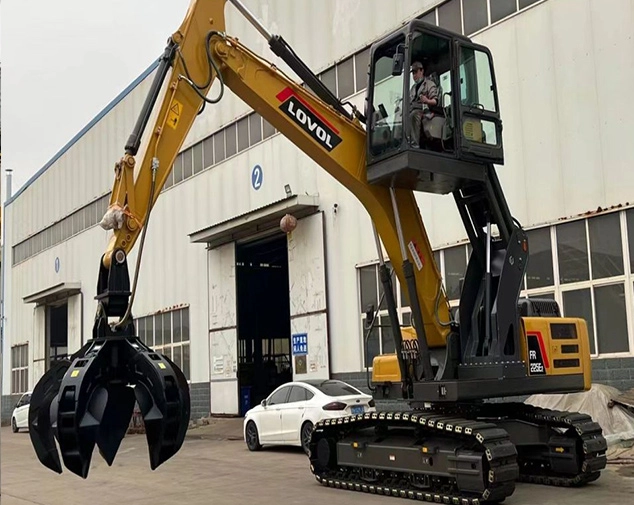
A clamshell bucket closes around material with two opposing shells. It contains the load. An orange peel grapple reaches into a pile with several curved tines, grips whatever it can hold, and leaves smaller pieces behind.
The correct choice depends less on the excavator itself than many buyers expect. Material shape, particle size, density, pile condition, and the type of loading work usually matter more.
What Is a Clamshell Bucket and How Does It Work?
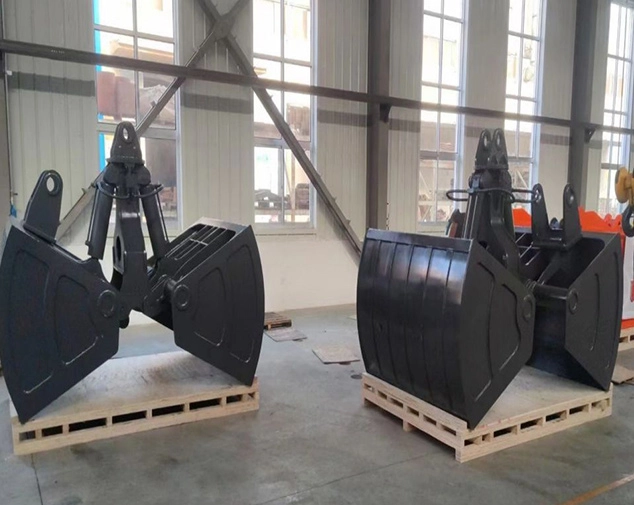
A clamshell bucket uses two hinged shells driven by hydraulic cylinders. When the shells open, the attachment is lowered over the material. The cylinders then pull the shells together, trapping the load inside.
Clamshell buckets are commonly used for sand, gravel, loose soil, coal, grain, fertilizer, and crushed material. They are especially useful when material must be picked up vertically rather than excavated from a face.
What Is an Orange Peel Grapple and How Does It Work?
An orange peel grapple uses four, five, or sometimes more curved tines arranged around a central frame. The tines open outward and close toward the center.
Instead of containing the entire load, the grapple clamps onto material from several directions. Open spaces between the tines allow dirt, small particles, and loose fragments to fall through. In a scrap yard, that is often useful rather than wasteful.
The design works well with irregular objects: steel offcuts, twisted rebar, demolition debris, rocks, timber waste, and mixed recycling material. The tines can enter gaps that a closed bucket cannot.
What Are the Main Differences Between a Clamshell Bucket and an Orange Peel Grapple?
Neither attachment is better in every job. A clamshell bucket is built around containment. An orange peel grapple is built around penetration and gripping.
| Comparison factor | Clamshell bucket | Orange peel grapple |
| Basic structure | Two opposing shells | Multiple curved tines |
| Best suited material | Loose, relatively uniform bulk material | Irregular, bulky, or tangled material |
| Fine material retention | High | Low to moderate |
| Pile penetration | Moderate | High |
| Sorting ability | Limited | Good |
| Typical applications | Sand, gravel, soil, coal, crushed material | Scrap metal, waste, rock, demolition debris |
| Loading method | Scoops and contains | Grips from several directions |
| Rotation | Optional for many jobs | Often valuable |
| Hard ground digging | Not recommended | Not recommended |
The material usually answers the question.
Fine gravel falls through an orange peel grapple. Bent steel sections do not sit neatly inside a clamshell bucket. Trying to force either attachment into the wrong application creates slow cycles, incomplete loads, and unnecessary wear.
Which Materials and Applications Are Best for Each Attachment?
Dry sand flows and settles. Scrap wire catches, bends, and pulls against nearby pieces. Broken concrete may include both small particles and long reinforcement bars. Those details shape the attachment choice.
When Should You Choose a Clamshell Bucket?
Choose a clamshell bucket when most of the material is loose, flowable, and reasonably consistent in size.
-
Loading sand, gravel, coal, or loose soil
-
Unloading bulk material from barges or rail wagons
-
Feeding hoppers with controlled quantities
-
Moving stockpiled aggregate
-
Handling crushed material where fine particle retention matters
-
Working in deep pits where vertical pickup is required
Containment is the main advantage. The two shells close around the material and reduce spillage during lifting and slewing..
When Should You Choose an Orange Peel Grapple?
Choose an orange peel grapple when the material is irregular, oversized, tangled, or difficult to scoop.
-
Loading steel scrap
-
Sorting demolition debris
-
Handling municipal or industrial waste
-
Moving rocks and oversized fragments
-
Feeding shredders and recycling equipment
-
Separating reusable material from mixed piles
The tines can reach between objects and close around awkward shapes. A five tine grapple working in mixed scrap may pick up less volume than a bucket, but the load is often more secure.
Which Attachment Offers Better Loading and Handling Efficiency?
Efficiency is not the rated bucket volume printed on a specification sheet. It is the amount of usable material moved during a working hour.
For sand and gravel, a shell bucket usually produces fuller, cleaner cycles. Less material drops during lifting. The operator also spends less time shaking the attachment to settle the load.
For scrap, an orange peel grapple is often faster because it does not need to scoop underneath the pile. The tines enter from above, close around irregular pieces, and pull them free. Rotation can shorten positioning time even further.
Watch the actual cycle. Where is time being lost? During penetration, closing, lifting, repositioning, or discharge? That observation is more useful than comparing capacity figures alone.
What Should You Check Before Matching Either Attachment to an Excavator?
Excavator tonnage is a starting point, not a complete selection method.
Check the attachment weight against the machine’s lifting capacity at the required working radius. A carrier may handle the attachment close to the tracks but feel unstable when the boom is extended over the side.
Hydraulic flow and working pressure must also match. Too little flow causes slow opening and closing. Excessive pressure can damage cylinders, hoses, or seals. A rotating orange peel grapple may require an additional hydraulic circuit.
Other checks include:
-
Pin diameter and mounting dimensions
-
Quick coupler compatibility
-
Required opening width
-
Maximum material size
-
Material density
-
Hose routing
-
Attachment height
-
Available transport clearance
-
Excavator counterweight and undercarriage condition
For bulk material work, buyers can compare these points with the model range on Kingho Technology’s excavator clamshell bucket specifications. The listed attachment weight, opening, hydraulic flow, and working pressure are more useful than excavator tonnage alone.
How Can You Decide Which Attachment Is Right for Your Operation?
Look at the worst part of the material pile, not the easiest part.
If the pile is mainly fine, loose, and uniform, a clamshell bucket will probably move more material with less loss. If the pile contains long, twisted, bulky, or interlocking objects, an orange peel grapple will probably spend less time fighting the load.
Mixed material requires a harder decision. A demolition contractor handling concrete fragments with occasional rebar may prefer an orange peel grapple because one tangled bar can stop a clamshell bucket from closing properly. An aggregate yard handling mostly crushed stone with a few oversized pieces will usually benefit more from the containment of a clamshell bucket.
Provide the attachment manufacturer with the excavator model, hydraulic information, material density, average object size, required capacity, and a few jobsite photos. Video is even better. Piles rarely behave exactly as they are described in an email.
FAQ
Q: Can a clamshell bucket handle scrap metal?
It can handle short, loose, and relatively uniform metal pieces, but it is usually not the best choice for tangled or oversized scrap. Long steel sections and wire can prevent the shells from closing completely.
Q: Can an orange peel grapple handle sand or gravel?
It can pick up coarse material, but fine particles will escape through the gaps between the tines. A clamshell bucket is normally more efficient when material retention is important.
Q: Does an orange peel grapple need 360 degree rotation?
Not always, but rotation is highly useful for sorting scrap, positioning the tines, and working in confined loading areas. Fixed grapples are simpler, though they may require more excavator movement.
Q: Is attachment capacity more important than attachment weight?
Both matter. Capacity affects the potential load per cycle, while attachment weight reduces the remaining lifting capacity of the excavator. A large attachment may carry less usable material if the machine cannot safely lift it at full reach.
Q: Which attachment is better for demolition waste?
An orange peel grapple is generally better for mixed demolition waste containing rebar, timber, pipes, and irregular concrete pieces. A clamshell bucket may be more efficient when the waste has already been crushed and screened into relatively uniform material.